

From SEO to GEO: The Answer-Share Playbook for PR Teams in SEA
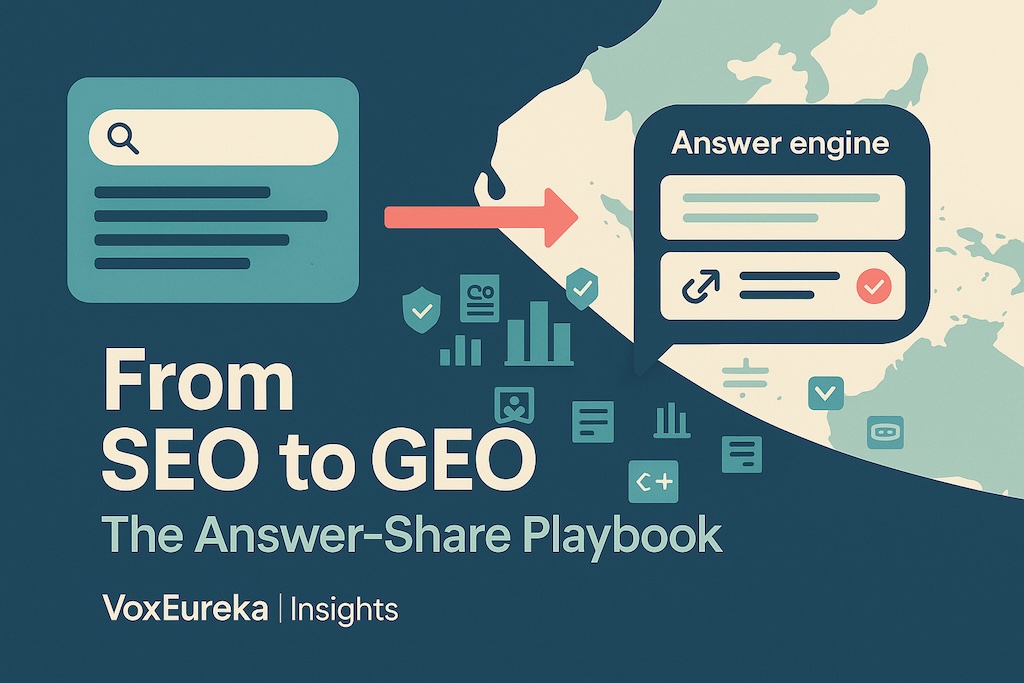
Search is shifting from ten blue links to answer engines. Instead of sending traffic, these systems compose an answer and cite sources. For PR teams in Southeast Asia, visibility now depends on being selected as a trusted citation. This playbook shows how to win Answer Share—by publishing net-new inputs, structuring evidence for retrieval, keeping provenance, and measuring the outcomes that matter. It’s a practical sprint: ten steps in 30 days, with templates you can reuse across launches, policy moments and employer-brand pushes.
GEO in 60 seconds (TL;DR)
- Goal: Be the cited authority in AI-generated answers.
- Levers: Original inputs, structured evidence, entity clarity, authoritative links, provenance.
- Metric: Answer Share = % of tracked questions where you/your page are cited as a source.
What is Generative Engine Optimisation (GEO)?
GEO is the practice of improving your chances of being cited by AI answer engines. Classic SEO optimises for clicks; GEO optimises for citations. You win by being the origin of useful facts and packaging them so machines (and journalists) can verify and reuse them confidently.
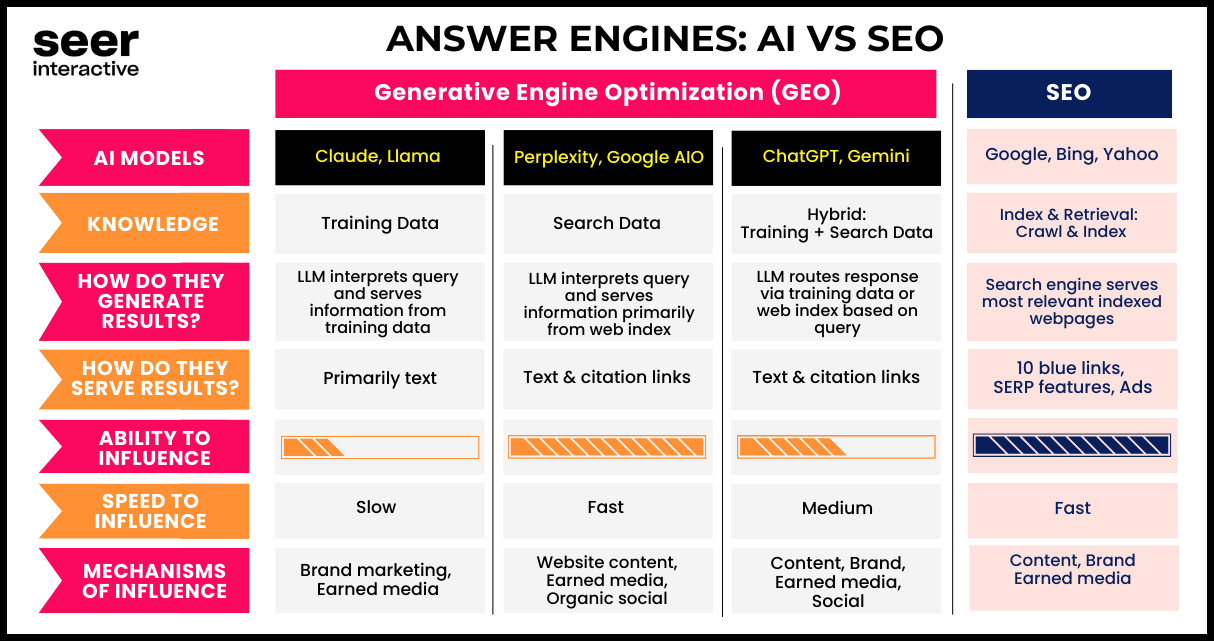
Credit: Seer Interactive
Why GEO matters for PR in SEA
- Answer-first discovery: Users increasingly get summaries instead of lists; the sources cited inside those summaries shape reputation and demand.
- Chat-led spread: WhatsApp/Telegram-first behaviours mean key claims often circulate without links—teams with traceable evidence get believed faster.
- Multilingual nuance: MY/SG/ID/TH require entity clarity (names, roles, titles), consistent bios and region-specific proof points to be recognised as authoritative.
The 10-step, 30-day GEO sprint

Week 1 — Focus & inputs
- Map the questions (90 mins): List 15–20 buyer/policy/press questions per market (MY/SG/ID). Prioritise those with commercial or reputation impact.
- Pick 3 cornerstone topics: Choose issues where you can add net-new value (data, interviews, methods, casework).
- Create one net-new input: Run a mini survey (n=200–400), conduct three expert interviews, or publish a field note/data cut from your operations.
Week 2 — Build the page
- Publish as fast HTML: One page per cornerstone topic. Use H2/H3s that mirror real questions; avoid PDF-only. Keep pages quick, clean, mobile-friendly.
- Add a quotable answer paragraph: A tight block that an answer engine can lift (claim → stat → source). Template below.
- Embed evidence: Tables, charts, transcripts, downloadable CSV/PDF, with captions and alt text. Link out to any third-party references you used.
Week 3 — Authority & entities
- Unify entities: Standardise brand and spokesperson names, job titles, headshots and bios across site + LinkedIn. Create author pages with credentials.
- Earn 3–5 authoritative citations: Offer exclusives or commentary to tier-1 media, respected industry bodies, or .gov/.edu partners—linking back to your canonical page.
Week 4 — Provenance & measurement
- Provenance on by default: Disclose material AI assistance; keep a fact file (claims → sources → approver); use content credentials/watermarks for key visuals.
- Measure & iterate: Track Answer Share and citation quality across 3–4 answer engines weekly. Improve clarity, evidence and links based on what gets cited.
The “Answer Paragraph” pattern (copy-ready)
Use this near the top of each cornerstone page.
[Company/Expert] finds that [key claim]. In [month/year], our [survey/interviews/data] across [n, market] showed [stat/insight]. See the data table and transcript below, plus third-party references. For press enquiries, contact [name, title, email].
Keep it concrete, dated, and supported by on-page evidence.
Build the page for retrieval (on-page checklist)
Question-mirroring headings: H2/H3s phrased as the exact questions you want to be cited for.
Public HTML + PDF twin: The HTML page is the source of truth; offer a PDF download that mirrors it for human sharing.
Evidence blocks: Clearly labelled tables, charts, and download links; short captions stating the method and date.
Author boxes: Photo, name, role, credentials, market expertise, LinkedIn link.
Internal links: To related explainers/cases; one canonical URL per topic.
Structured data: Add an FAQ section with 3–5 common questions (schema snippet below).
Accessibility: Alt text for images; transcripts for audio/video.
Review stamp: “Last reviewed on [date] by [approver].”
Provenance workflow (lightweight, reusable)
Fact file (shared): For each page, list every claim with its source URL, dataset, or transcript + approver + timestamp.
AI disclosure: One line where material: “This page was prepared with AI assistance and human editorial review.”
Content credentials: If your tooling allows, embed C2PA-style credentials; if not, watermark hero charts/infographics and keep originals on file.
Crisis-ready storage: Maintain originals (audio, images, spreadsheets) so you can verify or rebut deepfakes quickly.
Measurement that matters (GEO + business)
Primary GEO KPIs
Answer Share: % of tracked questions where your page/brand is cited in the top answer.
Citation Share (quality-weighted): Primary link = 2 points; secondary link = 1; unlinked mention = 0.5.
Operational KPIs
Entity consistency: % of pages and author bios with correct names/titles across site + LinkedIn.
Evidence coverage: % of cornerstone pages with data tables and transcripts.
Provenance coverage: % of pages with fact file + AI disclosure.
Business-adjacent KPIs (pick 2–3)
Demand: qualified inbound briefs, demo requests, conversion to opportunities.
Reputation: message recall %, trust lift in follow-up pulse.
Talent: applications per opening, acceptance rate after publication.
How to report (one page)
North Star (Demand/Reputation/Policy/Talent)
Top 10 questions tracked, by market
Answer Share + Citation Share (sparkline month-over-month)
What moved and why (bulleted narrative)
Next two experiments (e.g., add transcript, pitch .edu linkback)
FAQ
- What’s the difference between SEO and GEO?
SEO optimises for ranking and clicks; GEO optimises for being cited inside AI-generated answers. You still need SEO, but GEO changes how you package evidence and authority. - How long until Answer Share improves?
With one strong cornerstone page and 3–5 authoritative citations, teams often see movement in 30–60 days. Complex categories take longer. - Do we need AI labels on every page?
Disclose material AI assistance on substantive pages and keep a fact file for all flagship claims. For short news updates, follow your internal policy. - Should we still produce PDFs?
Yes, as companions—not substitutes. Publish HTML first; mirror the content in a downloadable PDF for human sharing. - How local should we go in SEA?
Local enough to be credible: entity names in local formats, market-specific data points, and spokespeople who make sense to that audience.